

Is Chrom Reaction Optimization for me?
If you’re a synthetic, organic, medicinal, process, or analytical chemist – or a lab manager or IT/data scientist – working in the pharmaceutical, biotech, or chemical industries, we hope this article will clarify the value and relevance of Chrom Reaction Optimization (Chrom RO) for your specific requirements.
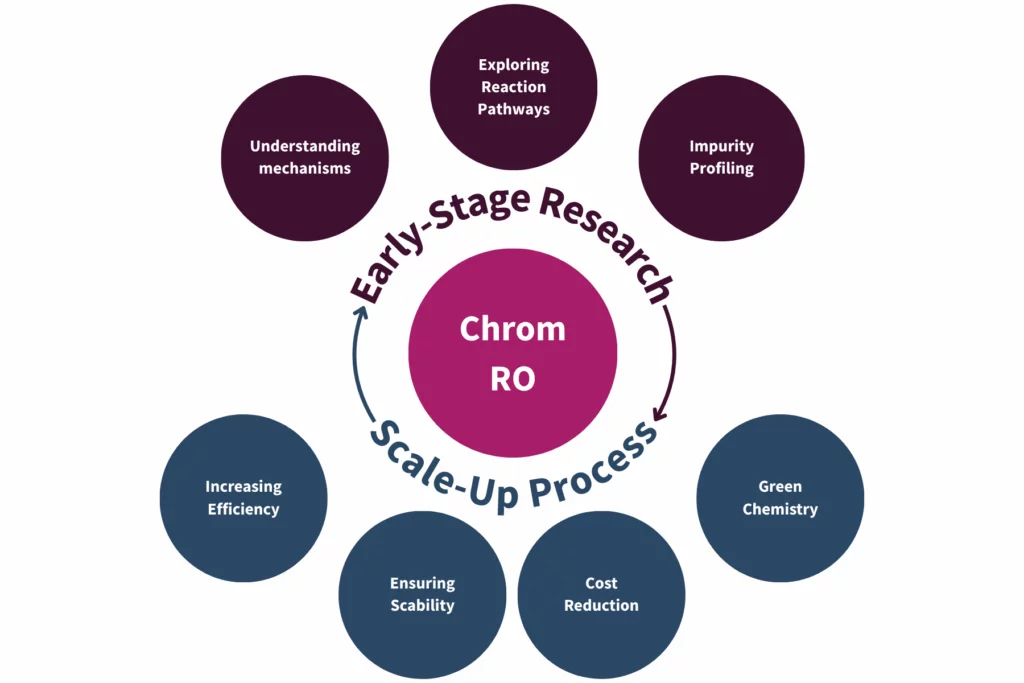
Chrom RO Empowering Development (Scale-up) Stages
Do you work in reaction scale up? Are you optimizing conditions, comparing dozens of reaction variables? If so, Chrom RO is built for you.
Imagine turning weeks of data crunching into just a few hours or days. Chrom RO is designed to be a game-changer in the development stages of the value chain. By tracking and quantifying a defined set of compounds in a reaction run in parallel under different conditions to employ. This not only accelerates the development process but also ensures that the most effective and efficient methods are identified and utilized for scale-up.
Chrom RO Value in Discovery
During the discovery phases, scientists may encounter reaction optimization while exploring pathways, understanding mechanisms, or conducting impurity profiling. Chrom RO is valuable in these processes, provided they involve studying the same reaction run in parallel under different conditions. When dealing with different reactions, such as parallel synthesis or library screening, customization through scripting is required.
Handling Large Volumes of Data
One of the standout features of Chrom RO is its ability to handle large chromatographic datasets seamlessly. So, if you regularly perform reaction optimizations and manage high volumes of analytical data, this solution will definitely change the way you tackle your work.
Gone are days of tedious manual processing for each sample. Chrom RO automates routine data processing, eliminating human errors such as transcription mistakes and number typos. This leads to better data quality and allows chemists to focus on what they do best – innovating and making informed decisions.
A Must-Have for Automated Reaction Optimization Settings
The integration of lab robotics into chemical synthesis has enabled rapid, closed-loop optimization with minimal human intervention. For users with automated reaction optimization, Chrom RO is essential. It automates data processing and analysis, providing results in dashboards for quick decision-making. This makes Chrom RO a powerful tool in the chemist’s arsenal.
Is Chrom RO Compatible with My Data Formats as Needs?
Chrom RO is compatible with any data format supported by Mnova. You can find a full list of these supported formats here. Below, we highlight the key features and capabilities of Chrom RO to help you assess how it aligns with your specific requirements:

And finally, it is critical to know that Chrom RO is so flexible that it allows you to script what to do with the output, enabling seamless integration with other software you may be using in your lab. This ensures that you can leverage the full potential of Chrom RO without disrupting your existing workflows. Output can be saved to your local folders, SQL and NoSQL databases, or even Electronic Lab Notebooks (ELNs) or Laboratory Information Management Systems (LIMS). These outputs can then be utilized by Business Intelligence (BI) and Artificial Intelligence (AI) tools, further enhancing your data analysis and decision-making processes.
