
Mnova Screen 2D

About Mnova Screen 2D
Mnova Screen 2D is a powerful data processing and analysis tool designed to extract qualitative insights from 2D NMR single-point titrations in screening campaigns, where chemical shift perturbations (CSPs) of a target molecule (e.g., a protein) are monitored. It automates the spectral processing, identifies peak correspondences between spectra, quantifies CSPs, and computes CSP-based scores that reflect target–ligand interaction strength. Screen 2D streamlines batch analysis of multiple ligands, reducing interpretation time and enabling rapid, reliable hit identification through intuitive visualization.
NMR Screening
Features
Batch 2D Spectra Processing
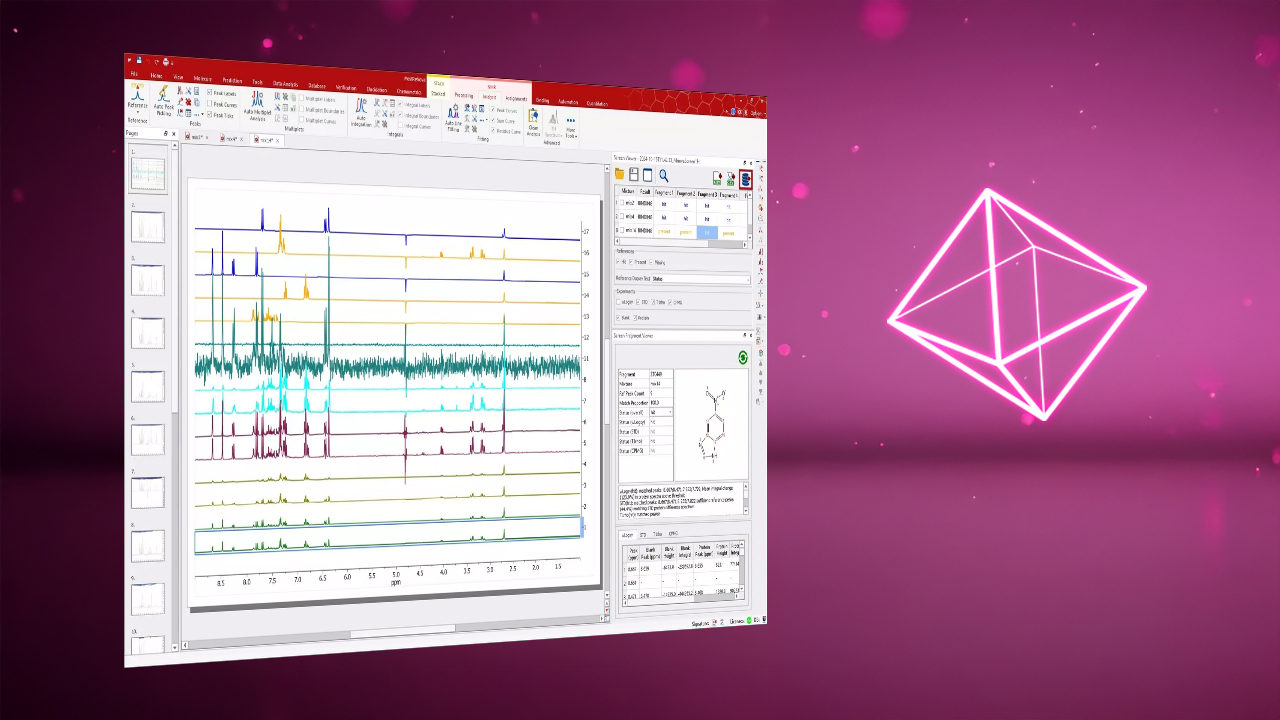
Screen 2D automatically analyzes large sets of 2D NMR data to speed up screening campaigns for multiple ligands against a common target.
Configurable Regions of Interest
It allows users to define included and excluded spectral areas to refine which peaks contribute to the global analysis.
Automated Peak Matching & CSP Calculation
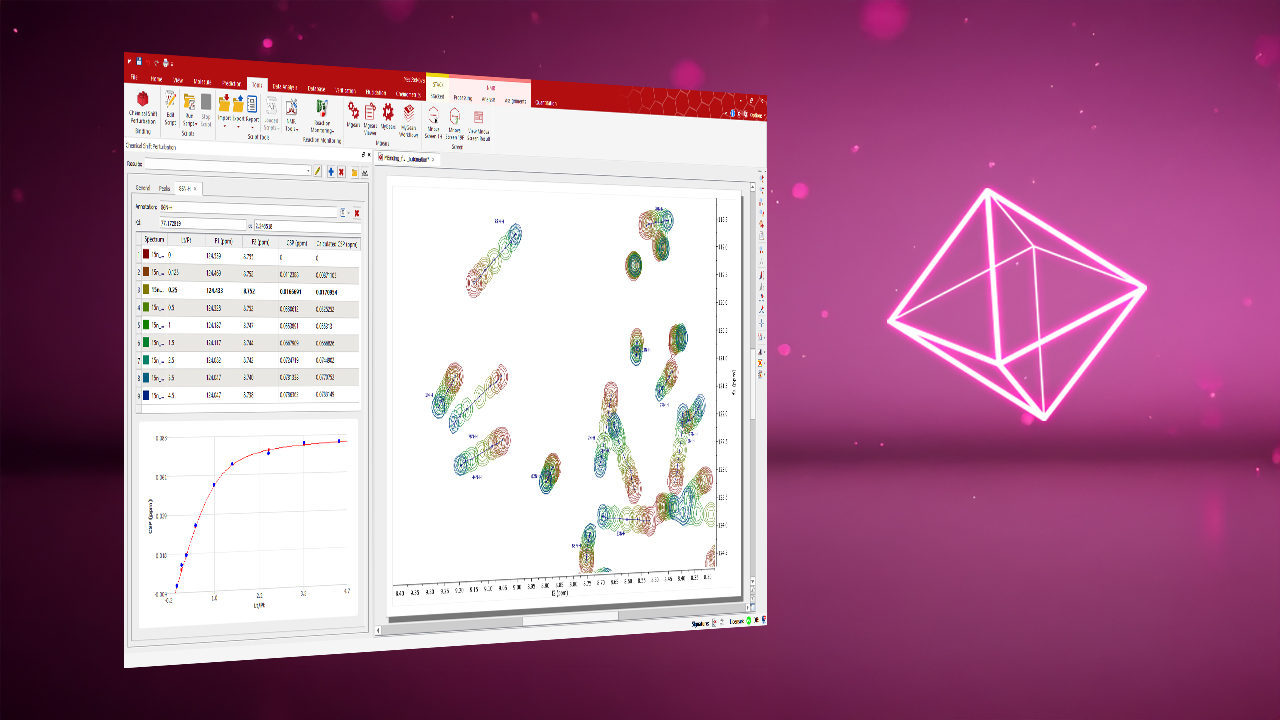
Screen 2D automatically finds and aligns peaks between paired spectra, the target alone and the target with ligand, using either Nearest Neighbor or Automatic Peak Tracing algorithms, then computes chemical shift perturbations (CSPs) for robust comparison.
Flexible CSP Scoring Definition
Users can set limits for scaling, maximum shifts, CSP-score weighting, Q-score thresholds, and category definitions such as "hit" or "aggregator".
Hit Classification
The software classifies ligands by CSP score and auto‑categorizes them as "hits" or "aggregators" using adjustable criteria tied to CSP distributions.
Interactive Visual Inspection
The Results Editor, CSP Editor, and Match Editor allows users to refine peak matching and interpret ligand-induced effects.

Benefits
Faster Discovery: Automated batch processing and clear ranking outputs reduce screening turnaround from days to hours.
Better Decision Confidence: Consistent CSP scoring and visual inspection tools help researchers trust hit selection and avoid false leads.
Consistent Results: Standardized workflows and automation ensure reproducible screening outcomes across projects and users.
Clear Prioritization: Statistical metrics make it easier to funnel the most promising binders into follow‑up studies.
Scalable Screening: Handle expanding fragment or compound libraries without bottlenecks in data analysis or interpretation.




Publications
- Peng. C., Namanja, A. T., Munoz, E., Wu, H., Frederick, T. E., Maestre-Martinez, M., Iglesias Fernandez, I., Sun, Q., Cobas, C., Sun, C., Petros, A. M. Efficiently driving protein-based fragment screening and lead discovery using two-dimensional NMR. Journal of Biomolecular NMR 77, 39-53 (2023). https://doi.org/10.1007/s10858-022-00410-3
- Peng, C., Frommlet, A., Perez, M., Cobas, C., Blechschmidt, A., Dominguez, S., Lingel, A. Fast and Efficient Fragment-Based Lead Generation by Fully Automated Processing and Analysis of Ligand-Observed NMR Binding Data. Journal of Medicinal Chemistry 59, 3303-3310 (2016). https://doi.org/10.1021/acs.jmedchem.6b00019

Curious about our products or services? Let us provide you with the answers you need. Contact us today and discover how we can cater to your needs effectively.