

Beyond Quality: PAT as a Catalyst for Carbon Reduction in Pharma

An In-Depth Article on PAT and Sustainability

Introduction – the urgent call for sustainability in pharmaceuticals

In modern pharmaceutical manufacturing, efficiency and sustainability are no longer separate priorities, but two sides of the same coin. Many sustainability strategies in pharmaceuticals are already emphasising the shift to relying on renewable energy sources such as solar and wind [1], and prioritising digitising their data to trace their environmental impact and increase their supply chain visibility [2]. As governmental targets for net-zero loom closer, the call for sustainability in all areas of development and manufacturing is becoming more urgent [3].

This urgency is coming from multiple directions. Firstly, governments are putting significant effort into quantifying their Scope 3 emissions, and imported medicines contribute significantly to this total. Sustainability considerations are becoming increasingly important to decision-making processes, with over 94% of healthcare professionals saying environmental sustainability will influence their treatment decisions by 2030 [4]. For example, in the UK, the NHS became the first healthcare system in the world to commit to a net-zero target in October 2020, and many other governments are not far behind. Medicines account for one quarter of the NHS’ total carbon emissions, with the rest mainly in manufacturing and the medicines supply chain [5]. By 2027, the NHS is requiring its medicines suppliers to publish meaningful carbon reduction plans, which highlights the urgent need to understand and improve sustainability within the pharmaceutical manufacturing industry [6]. This has led to pharmaceutical companies such as AstraZeneca to announce ambitious Net Zero carbon reduction plans, where they state they are on-track to reduce their Scope 1 and 2 greenhouse gas (GHG) emissions from their global operations by 98% by 2026 [7].


Read the full article:

Read the full application note:
Input value is invalid.
Please enter your first name
Please enter your last name
Please enter your e-mail address
Please fill out your job title.
Please enter your Company/Institution


Privacy Settings

To learn on my personal data, please read Bruker´s Privacy Notice and  Terms of Use.

I agree to share my contact details with Bruker Corporation and its affiliates for the purpose of fulfilling my request.

Even from these pressures alone, sustainability has become a matter of not only competitiveness [4], but business. Pharmaceutical companies that fail to reduce waste, emissions or resource, and track their environmental impact may find themselves excluded from contracts or overtaken by rivals who can demonstrate greener practices. Increasingly, procurement contracts are beginning to include environmental metrics [8].

Lastly, public perception and consumer expectations are shifting, with the strike to global net-zero being a combined effort. Whilst lowering end-product cost is still a main driver for consumers, McKinsey study showed that people are shifting their spending toward products with eco-friendly claims [9]. 81% of healthcare professionals would choose the more sustainable option if two products had equal safety and efficacy [4]. Patients and everyday consumers increasingly view environmental responsibility as part of healthcare’s duty of care, and companies that fall behind risk reputational damage in the eyes of the general public. Focusing on sustainability in medicines manufacturing, whilst also increasing positive public image, could also reduce the end-price of the product, due to a reduction in energy use and streamlined production techniques [10][11].

To stay competitive, the pharmaceutical industry can no longer afford to project their sustainability efforts into the future [11]. Companies must act now to build sustainability into their roadmaps and to employ Sustainability by Design (SbD) into their drug development procedures, as studies show 80% of a drug’s final environmental impact is determined during the early stages of process design [12]. The need to accurately measure carbon emissions in manufacturing processes is growing.

The pharmaceutical industry has welcomed Quality by Design (QbD) and Product Analytical Technology (PAT) into their manufacturing processes to reduce waste, product variability and time-to-market, whilst increasing process efficiency. The inherent sustainability benefits of QbD and PAT are not often discussed, but should not be overlooked [13].

Employing QbD and PAT not only leads to cost savings due to operational excellence, but it can also help tackle the environmental pressures that the pharmaceutical industry face today [13].


What is PAT?

Process Analytical Technology (PAT) is a system for designing, analysing, and controlling manufacturing processes through timely measurements of critical quality and performance attributes. Instead of relying solely on end-product testing, PAT enables continuous or frequent in-line monitoring, allowing real-time adjustments. More efficient processes also result in greater production capacity, and less waste due to more predictable manufacturing [6].

Key tools for PAT, according to the FDA’s Guidance for Industry for Innovative Pharmaceutical Development, Manufacturing and Quality Assurance (2004) [14], can be split into four distinct areas:

1.      Process analysers:

Analytical instrumentation, one of the fundamental tools required to enable PAT, are installed in-line or on-line, and directly measure CPPs in real time. Tools include near-infrared (NIR) spectroscopy, Raman spectroscopy, biosensors and more for continuous, non-destructive monitoring.

2.      Multivariate tools:

Taking the data from these process analysers, software that performs a range of techniques, from simple statistical calculations to advanced chemometrics, will support experimental design and perform multivariate analysis. These multivariate tools enable immediate detection of critical quality attributes (CQAs) through predictive modelling.

3.      Process control:

Control systems can use the sensor data and multivariate predictions to maintain process parameters within defined limits through the use of responsive feedback or feed-forward control, always keeping processes within specified limits.

4.      Continuous improvement and knowledge management:

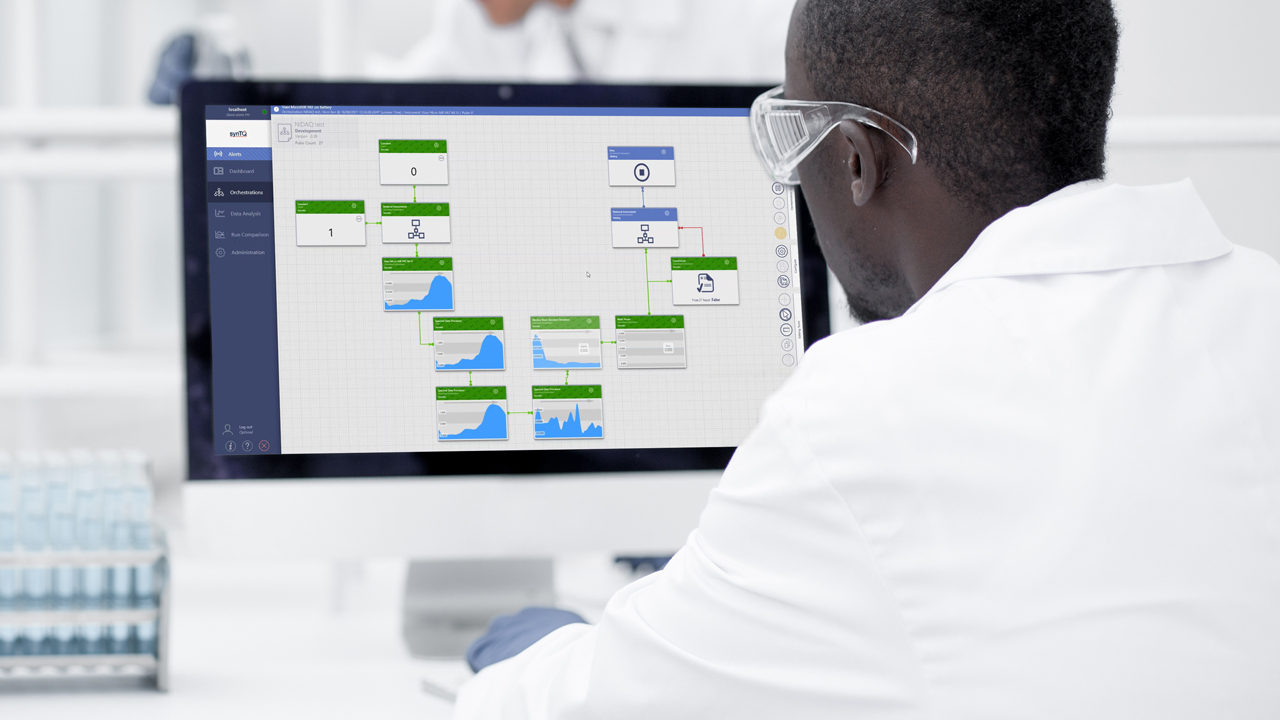
It is key to log and aggregate this QC data and process insight over time to support trend analysis and empower root-cause investigation and continuous improvement of a process. A knowledge management platform (such as synTQ) is an important step in long-term process optimisation and control strategy updates, whilst enabling compliant data storage.

It is well-established that, using these tools, PAT can provide significant quality and commercial benefits, which results in faster development and manufacturing cycles, as well as reduced cost due to waste reduction [15].

The sustainability benefits of PAT, in practice

Sufficiently harnessing a data-driven control solution such as PAT techniques can not only improve manufacturing processes via real-time monitoring, intelligent control and quality predictions, but it could also result in a transformative solution for manufacturing of drugs, aligning operational performance with sustainability objectives.

  • Improved yield
    Real-time adjustments that keep the process within its optimal operating window will maximise the usable product per batch. This is especially important for biologic processes, where significant time and materials could be wasted by having to re-start or re-work.
    For example, through using PAT and synTQ control, one large pharmaceutical company implemented a Raman spectrometer to control their fed-batch bioprocess. By predicting the glucose concentration within the batch in real-time, the glucose level was able to be controlled within its ideal threshold, creating the optimal conditions for cell growth and eliminating batch loss and waste due to feeding errors. As a result, this company was able to triple the titre of their bioprocess [16].

    By using PAT, more production per unit of energy input was achieved. This means a lower energy intensity value for the product, which many pharmaceutical companies use as a sustainability performance metric.

    More successful batches mean no need to run extra batches to meet volume targets, which reduces 100% of raw material use of these extra batches, including solvents and water. And by achieving this higher yield, the size of facilities and amount of equipment required could also be reduced.
  • Reduction of over-processing
    Real-time monitoring and modelling with PAT will detect when a process step’s endpoint is reached, and this can be used across a broad range of unit operations such as blending (to predict blend uniformity), drying (to predict moisture content), or crystallisation (to predict state). Instead of running for fixed, conservative durations, equipment can be stopped immediately [17].

    PAT can be used to reduce the running of equipment for longer than necessary, which results in direct energy consumption savings. Shorter runtimes for mixers, dryers, millers and reactors mean less electrical and/or steam energy is consumed
  • No repeat batches
    In a traditional set-up, if a process deviation is only discovered after an offline QC, the entire batch might need to be reprocessed or even discarded. With PAT, an in-line sensor detects deviations as they happen, allowing operators or automated control systems to adjust these parameters in real time, preventing the process from drifting out-of-spec [19].

    Implementing PAT maximises energy efficiency by reducing the need for additional processing time of additional unit operations, and reduces waste by preventing large volumes of out-of-specification material.

    A large-scale pharmaceutical company found that up to 45% of the total water consumption at their site was due to Cleaning-in-Place (CIP) [20]. Avoiding reprocessing means less Clean-in-Place (CIP)/Sterilise-in-Place (SIP) cycles, reducing the consumption of hot water, steam and detergents. Whilst exact figures for water usage for one CIP cycle varies for each specific situation, companies could save 1000-2000L of water per batch with PAT, by reducing the need for repeat batches [21].

    PAT can also provide continuous data on how much material is being lost from a process, and operators can focus on continuous improvement of process steps, to minimise losses in future runs [17].
  • Reduction of excessive heating & cooling
    The principles of Green Chemistry, which outline engineering principles that make a greener chemical process or product, directly cite real-time analysis for pollution prevention and energy-efficient process design as central tenants. The American Chemical Society directly mention PAT as a key enabler of this, by implementing sensors to confirm exact target moisture, temperature or crystallinity, and allow heating and cooling to stop the moment the specifications are met [22].

    By avoiding unnecessary steam generation or chiller power, we reduce energy consumption, as well as extending the life of the machines due to less degradation from over-heating or over-cooling. Reducing this thermal energy demand cuts CO2 emissions from boilers and refrigerants’ indirect emissions from energy use. This point is especially relevant if the production line is in a climate that already challenges the facility’s control system. If the process is heating for longer than necessary, the cooling system in the facility is being strained even more to keep the manufacturing environment in a range suitable for the facility and its employees.

Case study

With PAT, processes run closer to optimal conditions, for longer. With the process efficiency improvements described above, for one oral solid dose (OSD) manufacturer, moving from a batch to a continuous process using PAT, reduced projected production time from 30 days to around 90 minutes [16]. This results in over a 90% reduction in total process time and an increase of productivity by over 2000% to make the same amount of product. The energy consumption is greatly lowered across the facility, which directly cuts the carbon footprint of the process.


In this scenario, one of the unit operations that benefitted greatly from PAT automation was the Blending process, a critical step in the production.

Traditionally, operators would run a conservative, fixed time blend of the solids. To determine the blend uniformity, the blend would be sampled using a sample thief (which disturbs the blend uniformity), and laboratory analysis of the samples using HPLC would be performed to confirm the desired blend was achieved [23].

A common PAT strategy for monitoring blend uniformity is to install a process analyser, typically an NIR spectrometer, in-line at the blend site to monitor the blend in real time. When the blend becomes uniform, the spectra begin to show statistical homogeneity. By using a simple statistical calculation (such as a moving F-test), the PAT method provides a real-time indicator of homogeneity and therefore blend uniformity. Blending can be stopped as soon as this test is passed [24].

The practical impact is immediate: shorter blending cycles mean less motor run-time, giving a direct energy consumption reduction. Using a technique such as this, a nominal blend duration could go from 10 minutes, down to 3 minutes. This is roughly a 70% energy reduction [23]. Considering the cumulative savings across thousands of batches, PAT-driven blend end-pointing becomes a measurable contributor to plant-level energy efficiency and sustainability targets. Over-blending a product could damage the blend itself through production of fines and an unwanted reduction in particle size, so blending until we reach statistical homogeneity can also result in decreased product re-work or additional process steps.

While there is not a standard consumption rate for solvents when running HPLC, the potential reduction is estimated to be up to 1.5L per batch. Eliminating the need for routine offline HPLC/UV confirmation means we totally avoid this solvent usage [25].

As the proposed efficiency and contribution to sustainability above applies only to the blending unit operation, if deployed across an entire manufacturing line, PAT has the potential to be a significant help towards achieving sustainability goals.

Strategic implications

PAT might have been implemented in the first place to achieve process control and real-time quality assurance, but there is significant evidence to suggest that using PAT moves sustainability goals from being an “add on” to being an integrated operational capability. It’s now measurable, reportable and improvable. Using PAT, pharmaceutical companies can directly show the commitment to net-zero is backed by a PAT-driven reduction of kWh/kg (or CO2e/kg) product.

PAT-enabled sustainability performance, which includes lower energy intensity, reduced waste and faster release, can become a differentiator in a market where sustainability performance is increasingly influencing decision-making. PAT has the potential to expand beyond its original use-case and become a vital source of evidence for sustainable manufacturing that will be readily recognised by regulatory authorities.

As environmental regulations tighten, PAT provides the traceable, real-time data needed for compliance and verification, without costly retroactive data collection. It also reduces the level of estimation necessary at plants that produce multiple products, or only parts of products. With PAT tools, such as process analysers and knowledge management tools, it is possible to get accurate readings of which processes are most energy intensive. This data can be used to identify inefficiencies, and provide the knowledge and evidence needed to implement improvements that reduce material and energy use.

By using PAT-enabled energy savings in annual reports, these transparent, data-backed claims of sustainability gains strengthen any pharmaceutical company’s reputation in the public eye as one that is working to protect the environment.

Free eBook:

‘QbD & PAT for Dummies’ offers a simple and easy to follow guide on what Quality by Design (QbD) and PAT are, the regulatory framework supporting these approaches, as well as how leveraging these concepts can positively transform production processes and quality testing.

Conclusion: PAT as a Green Manufacturing Catalyst

The pharmaceutical industry stands at a pivotal intersection of innovation, regulatory expectation and environmental responsibility. PAT is more than a quality tool. It’s also a strategic enabler of sustainability.

In an era where regulators demand robust quality assurance, customers prefer sustainable products, and governments worldwide are accelerating decarbonisation commitments, adopting PAT is no longer just a technological advantage, but a business imperative.

By embedding real-time process understanding into manufacturing, PAT reduces unnecessary process time, eliminates repeat batches, minimises excessive heating and cooling, and cuts the need for offline testing. The resulting gains of lower energy consumption, reduced material usage, decreased waste and fewer emissions directly support sustainability targets and align with the global push towards net-zero.

Most forward-thinking companies will see PAT not just as a compliance measure, but as a central pillar of their sustainability growth strategy. By adopting PAT, companies directly address the core sustainability drivers that shape modern manufacturing and are therefore positioning themselves as leaders in sustainable healthcare manufacturing, ready to meet both the market and planetary needs of tomorrow.

References

[1] Sustainability in the pharmaceutical industry

[2] Supply chain visibility strategic priority for pharma | EY - UK

[3] Net Zero Coalition | United Nations

[4] Pharma’s green frontier: the next competitive advantage in healthcare

[5] B1728-delivering-a-net-zero-nhs-july-2022.pdf

[6] Net zero: progress on reducing the environmental impact of medicines - The Pharmaceutical Journal

[7] Sustainability | AstraZeneca UK

[8] “Invest in sustainable pharma today in preparation for tomorrow” - European Pharmaceutical Manufacturer

[9] Do consumers care about sustainability & ESG claims? | McKinsey

[10] Why Pharmaceutical Products Need Sustainable Packaging

[11] Research: How sustainability is changing consumer preferences - Capgemini UK

[12] Sustainability by Design in the Context of Bioprocess Development

[13] Pharma Process Analytical Technology | Is It Time for PAT to Go Green? | Pharmaceutical Manufacturing | Pharma Manufacturing

[14] PAT — A Framework for Innovative Pharmaceutical Development, Manufacturing, and Quality Assurance | FDA

[15] What is PAT? | Bruker

[16] synTQ customer use-case.

[17] Process Analytical Technology - Pharmaceutical Industry Perspective

[18] Optimisation of fluid bed dryer energy consumption for pharmaceutical drug process through machine learning and cloud computing technologies. Roberto Barriga Rodriguez, Universitat Politecnica de Valencia, 2023

[19] Revolutionizing Pharmaceutical Manufacturing: The Role of Process Analytical Technology in Minimizing Waste | Tablets and Capsules Magazine

[20] Cutting down water consumption in the pharmaceutical industry

[21] Determining Rinse Times for CIP Processes - Cleaning Validation

[22] 12 Principles of Green Engineering - American Chemical Society

[23] Pharmaceutical Process Control | Introducing PAT, Using NIR Analysis, to a Pharmaceutical Blending Process | Pharmaceutical Manufacturing | Pharma Manufacturing

[24] Blend uniformity evaluation during continuous mixing in a twin screw granulator by in-line NIR using a moving F-test - PubMed

[25] Increasing Chromatographic Productivity and Reducing Solvent Consumption with ACQUITY UPLC | Waters